Guide
Bathtub refinishing cost: what drives it and the safety rule
Bathtub refinishing cost depends on prep, repairs and coverage. What reglazing is, what moves the price, and the stripper chemical that has killed refinishers.
Updated October 26, 20266 min readReviewed by BathBudget Editorial Team, editorial review: primary sources checked and independently fact-checked
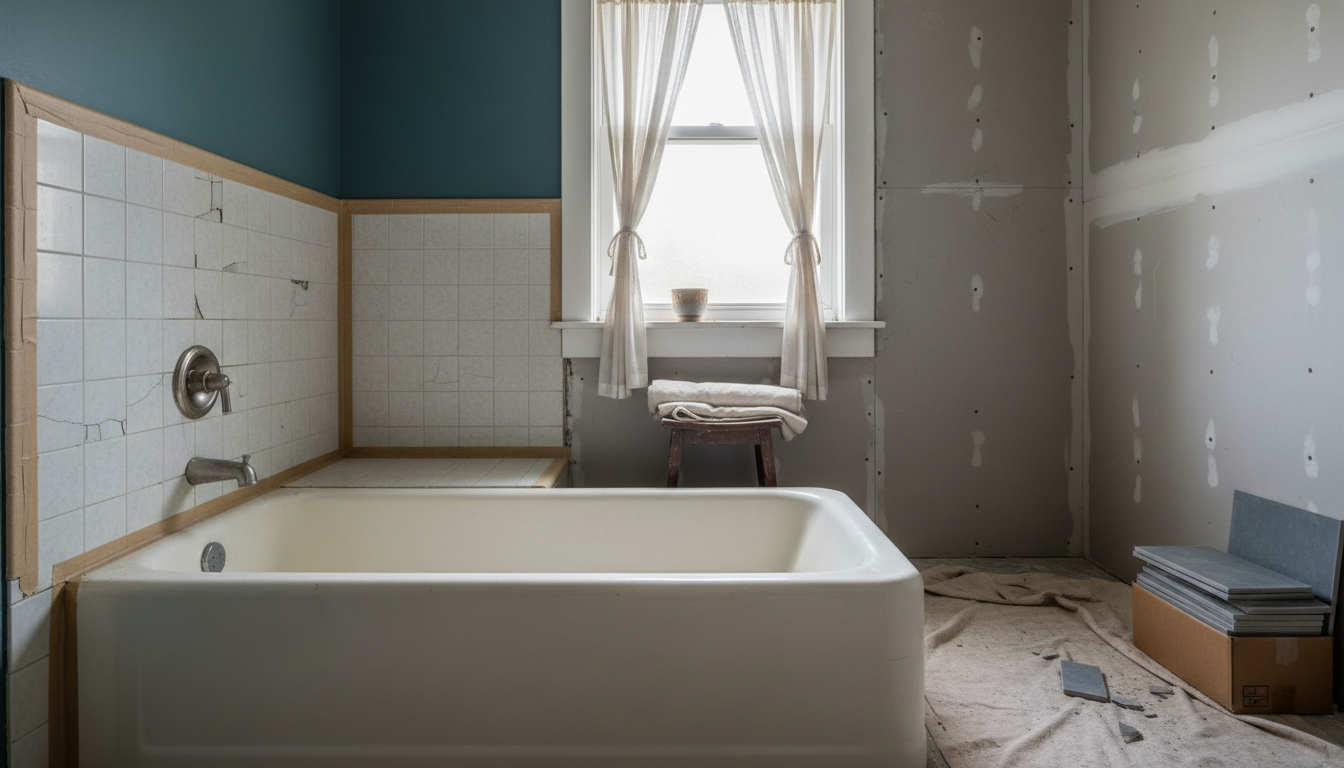
Bathtub refinishing cost comes down to how much preparation and repair your tub needs before the new coating goes on, and we couldn't find a federal or state source that publishes a price for it. It is the cheaper way to fix a stained or worn tub that still works, and OSHA and NIOSH call it a less costly alternative to replacing the tub. What a quote leaves out matters too, and that includes which chemical the refinisher plans to use in your bathroom.
What bathtub refinishing (reglazing) actually is
The OSHA/NIOSH hazard alert defines it plainly. It restores the surface of an old bathtub to improve its appearance and repair surface damage. The usual process removes the existing finish, then applies a new coating, "usually a synthetic finish such as polyurethane or epoxy." The same alert warns that the process "often involves the use of hazardous chemicals including methylene chloride, acids and isocyanates."
So "bathtub reglazing" and "bathtub refinishing" are two names for one job. The tub stays where it is, and nobody touches the plumbing, the walls or the floor. That's why it costs less than replacing the tub, and also why it can't fix anything behind the surface.
What drives bathtub refinishing cost
We couldn't find a federal or state source that publishes a price for reglazing a tub, and the prices quoted online are all over the place, so we won't put a number on it. What we can tell you is what a quote should cover, so two of them can be compared fairly:
- Preparation. Has the tub been refinished before? An old coating that has to come off is more work than cleaning and etching an original surface. Ask how the refinisher plans to remove it.
- Repairs before coating. Chips, rust spots and worn patches usually need filling first. Ask whether the quote includes them or prices them separately once the work starts.
- What's included. The tub alone, or the tile surround and the sink too? Each surface is its own line.
- Ventilation and containment. Exhaust equipment and sealing off the rest of the room are part of doing the job safely, so the quote should say how they're handled.
- The written terms. What the warranty covers, for how long, and what voids it (abrasive cleaners, for example). We couldn't find a government source that sets a lifespan for a refinished tub, so the written terms are the only promise you get.
To see how a reglaze compares with the cheapest remodel scope where you live, use the estimator. It shows the range for a surfaces-only job and for a full remodel, with the labour share adjusted to your state.
For how the rest of a bathroom budget breaks down by scope, see what a bathroom remodel costs. If you're comparing written quotes, what a bathroom quote should itemise lists the lines to check.
The safety fact behind bathtub reglazing
This part matters more than the price. Methylene chloride (also called dichloromethane) is a paint stripper that has been used to take old coatings off bathtubs, and it has killed the people doing the work.
A CDC report published on February 24, 2012 linked methylene chloride stripping agents to at least 13 deaths of bathtub refinishers in the United States since 2000. "Each death occurred in a residential bathroom with inadequate ventilation." Respirators either weren't worn or weren't adequate. The authors concluded that "in a small, enclosed bathroom, it is unlikely that a methylene chloride stripping agent can be used safely." The 2013 OSHA/NIOSH alert raised the count to at least 14 worker deaths since 2000.
The alert explains why a bathroom is so dangerous for this:
- "Bathroom fans or open windows do NOT provide adequate ventilation." The vapor collects in the bottom of the tub and builds up quickly in a small room.
- You can't rely on smell. Methylene chloride can't be smelled until the level in the air is already above OSHA's permissible exposure limits.
- It doesn't take much: "Exposure to as little as six ounces of methylene chloride-based material has been enough to cause death."
- There are other ways to strip a tub. The alert names sanding as one, and warns that substitute products carry hazards of their own.
Workers aren't the only ones at risk. CPSC staff note that homeowners and building occupants, as well as workers, have died after these strippers were applied. Their advice when you hire someone:
- keep the people who live there isolated from the work area during and after the stripper goes on;
- expect local exhaust ventilation, since a bathroom fan or an open window isn't enough;
- ask for the product literature and safety data sheets for what will be used in your home;
- check that the contractor is trained to use the product safely, and verify their insurance, licences and references.
What the law says about methylene chloride now
Two federal rules, both under the Toxic Substances Control Act, now cover this.
The 2019 consumer rule. EPA's March 2019 rule prohibits manufacturing, processing and distributing methylene chloride for consumer paint and coating removal. After November 22, 2019, retailers, online sellers included, can't distribute methylene chloride products for paint and coating removal. It is codified in 40 CFR Part 751, Subpart B, §751.105.
The 2024 rule. In April 2024, EPA finalized a broader rule that prohibits methylene chloride for all consumer uses and for most industrial and commercial uses, "including paint and coating removers." Under §751.107 of the same subpart, commercial use is prohibited after April 28, 2026. The uses still allowed, listed in §751.107 and §751.109, are a short list, such as stripping safety-critical aircraft and spacecraft parts and, until May 8, 2029, refinishing wooden furniture and fixtures of artistic, cultural or historic value. Bathtubs aren't on it.
Old stock may still sit in garages and workshops. CPSC staff recommend not using any methylene chloride stripper bought before November 22, 2019, and say these products should never be used in enclosed spaces such as bathrooms. Their fact sheet was written before the 2024 rule and still says commercial use isn't prohibited. That changed on April 28, 2026. Asking what product goes on your tub is still worth doing, and other strippers have their own hazards.
When refinishing is the wrong answer
A reglaze changes the surface, so any problem under the surface stays where it is. Refinishing is the wrong choice when:
- water is getting behind the wall or under the floor, shown by staining on the ceiling below, loose tile or a soft spot;
- the subfloor near the tub flexes or has rotted;
- the tub is cracked through, not just chipped on the surface;
- the layout itself is the problem, or someone in the house can no longer step over the tub wall.
Here are the three routes, in order of how little they ask of you:
If a salesperson is pitching a liner over the old tub instead, what a one-day bath system really costs explains that category. If you signed a contract at home and regret it, read how to cancel a bathroom contract before the three business days run out. A small room doesn't always mean a small bill, as small bathroom remodel cost explains.
Bottom line
Bathtub refinishing cost is mostly preparation, repairs and how many surfaces are included, so get it itemised in writing. Then ask the safety question: which stripper and which coating will be used, and how the room will be ventilated and closed off from the rest of the house. If the tub leaks, the floor is soft or the tub is cracked through, a new coating won't fix it.
Common questions
Is bathtub refinishing the same as reglazing?
Yes, the two words describe the same job. OSHA and NIOSH describe it as restoring the surface of an old tub, usually by removing the existing finish and applying a new coating such as polyurethane or epoxy.
Is it safe to stay home while a bathtub is refinished?
Ask before the day. CPSC staff advise that people living in the home be kept away from the work area during and after a methylene chloride stripper is applied. They add that a bathroom fan or open window doesn't count as adequate ventilation.
Can a refinisher still use methylene chloride stripper?
Federal rules now prohibit it for this job. Retailers have been barred from selling methylene chloride paint removers to consumers after November 22, 2019. Under EPA's 2024 rule, most commercial use, bathtub stripping included, is prohibited after April 28, 2026.
Can I refinish a bathtub myself?
Kits exist, but stripping is where the danger lies. CPSC staff say consumers should never use methylene chloride products in enclosed spaces such as bathrooms. They also recommend not using any methylene chloride stripper bought before the 2019 ban.
When is refinishing the wrong choice?
When the problem is under the surface: a leak behind the wall, soft or rotted subfloor, or a tub that is cracked through. A new coating only changes the surface, so the damage stays.
Sources
- OSHA/NIOSH Hazard Alert: Methylene Chloride Hazards for Bathtub Refinishers (2013)
- CDC MMWR: Fatal Exposure to Methylene Chloride Among Bathtub Refinishers, United States, 2000–2011 (February 24, 2012)
- CPSC staff: Methylene Chloride and Paint Strippers, Health and Safety Recommendations for Consumers
- EPA: Final Rule on Regulation of Methylene Chloride in Paint and Coating Removal for Consumer Use
- EPA: Risk Management for Methylene Chloride
- eCFR: 40 CFR Part 751, Subpart B (Methylene Chloride)
By BathBudget Editorial Team. First published October 14, 2026. Advertiser disclosure
Keep reading