Guide
Bathroom demolition cost: what the demo line should cover
Bathroom demolition cost depends on what comes out, how the debris leaves and how old the house is. The lines a demo quote should list, and the lead and asbestos rules.
Updated November 7, 20268 min readReviewed by BathBudget Editorial Team, editorial review: primary sources checked and independently fact-checked
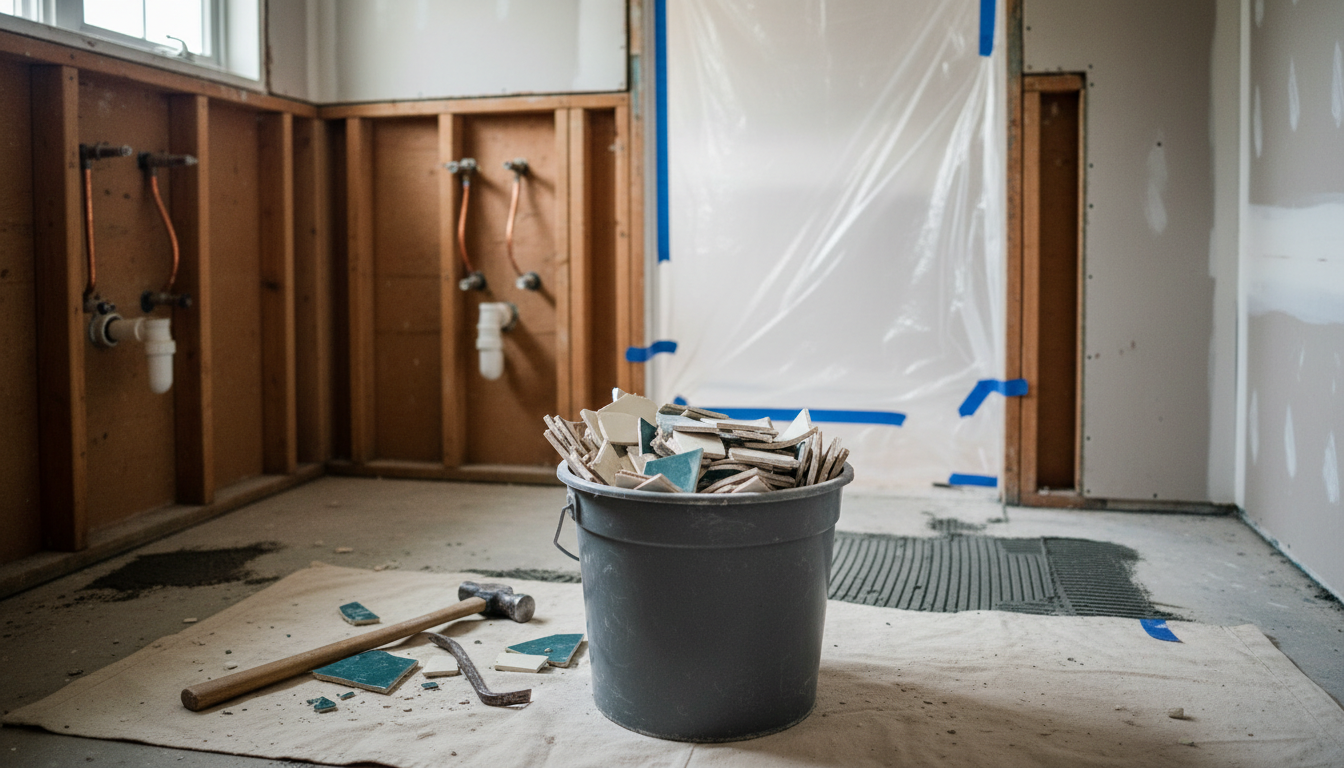
Bathroom demolition cost depends on three things: how much comes out (fixtures only, or tile and wallboard down to the studs), how the debris leaves the house, and how old the house is. The first two are labour and disposal. The third is easy to leave off a quote: in a home built before 1978, or one with old vinyl flooring, tile or mastic, the demo may fall under federal lead paint rules or need an asbestos check before anyone swings a hammer.
What bathroom demolition cost covers
Demolition is the first trade into the room, and it's mostly labour plus disposal. The Bureau of Labor Statistics lists cleaning and preparing construction sites "by removing debris and possible hazards" among the duties of construction laborers and helpers, and puts their median annual wage at $46,680 as of May 2025. That's what the worker earns, not what a contractor charges per hour.
These are the lines that make up the demo price. Get each one in writing:
| Line | What to ask |
|---|---|
| Scope of tear-out | Fixtures only, or tile, mortar bed, wallboard and subfloor too? Which walls, and down to what layer? |
| Heavy or awkward items | Is a cast iron tub, a mortar-set shower or a tiled-in vanity coming out, and is that priced separately? |
| Utilities | Who shuts off and caps the water supply and drain lines, and who makes the electrics safe? |
| Protection | How are the floors and rooms on the route out covered, and is the doorway sealed against dust? |
| Haul-away and disposal | A dumpster, a trailer or bagged debris? Who orders it, who pays any dumpster or street-use permit, and are disposal fees included? |
| Cleanup | Broom-clean, or vacuumed and wiped? |
| Testing | Is there lead paint or asbestos testing, who does it, and is it in this price? |
| Surprises | What is the written process and rate if rot, mold, lead or asbestos is found? |
Quotes that look far apart are often just drawing the demo line in different places. One includes disposal, another leaves the debris in your driveway, a third assumes everything comes out cleanly. Our guide to what a bathroom quote should itemise covers the rest of the quote. To put the demo lines from each contractor side by side:
Bathroom demo cost in a pre-1978 home: the lead paint rule
If the house was built before 1978, EPA says it may have lead-based paint, and that if you don't know when it was built, "it's safest to assume the area you are renovating has lead-based paint." Painted bathroom walls, ceilings, trim and doors are all in play.
EPA's Renovation, Repair and Painting (RRP) rule says that, in general, "anyone who is paid to perform work that disturbs paint in housing and child-occupied facilities built before 1978 must be certified." There's a small-job exception for minor repair, but under 40 CFR 745.83 it doesn't apply where the work involves "demolition of painted surface areas." When painted parts are removed, the entire surface area removed counts as paint disturbed. A gut demo in a pre-1978 bathroom is covered.
The rule doesn't apply if the paint is shown to be lead-free. Under 40 CFR 745.82, that means a written determination from a certified inspector or risk assessor, or testing of each affected component by a certified renovator, either with an EPA-recognised test kit or with paint chip samples sent to an EPA-recognised lab. If testing clears the room, the lead-safe steps below aren't required. Ask whether testing is in the quote and who does it.
How the rule treats homeowners doing their own work, and the Renovate Right pamphlet a firm must give you before starting, are covered in how to remodel a bathroom.
What lead-safe demolition adds to the quote
This is why a certified firm's demo price can be higher than an uncertified one's. The work practice standards in 40 CFR 745.85 require the firm, among other things, to:
- post signs warning people to stay out of the work area, and keep them up until the cleaning check is done;
- isolate the work area "so that no dust or debris leaves the work area," close and cover ducts, and cover doors used as entrances with plastic sheeting that workers can pass through;
- cover the floor with taped-down plastic sheeting "6 feet beyond the perimeter of surfaces undergoing renovation or a sufficient distance to contain the dust, whichever is greater";
- avoid open-flame burning of painted surfaces, keep heat guns below 1,100°F, and use sanders or grinders on painted surfaces only with a shroud and HEPA vacuum attachment;
- contain waste before it leaves the work area, cover any chute, and contain waste in transport;
- clean with a HEPA vacuum and damp cloths, then have a certified renovator verify the cleaning with a wipe test against a cleaning verification card.
Afterwards, under 40 CFR 745.86, the firm must give the owner information about how it complied "when the final invoice for the renovation is delivered or within 30 days of the completion of the renovation, whichever is earlier," and keep its records for 3 years. Ask for that paperwork with the final invoice.
To check a contractor, EPA's consumer page links to a search for EPA or state lead-safe certified firms in your area.
Asbestos in old floor tile, sheet flooring and mastic
Old bathroom floors are the other thing to check. EPA's list of products that may contain asbestos includes "vinyl floor tiles and the backing on vinyl sheet flooring and adhesives," and "textured paint and patching compounds used on walls and ceilings." Tearing up an old floor, or scraping the black adhesive under it, is exactly the kind of disturbance that matters.
EPA's homeowner guidance says:
- "Generally, you can't tell whether a material contains asbestos simply by looking at it, unless it is labeled."
- Planning a remodel is one of the reasons to consider an inspection by a trained and accredited asbestos professional, and "Taking samples yourself is not recommended."
- Materials may release fibres when they are "disturbed, damaged, removed improperly, repaired, cut, torn, sanded, sawed, drilled or scraped." It also says not to sand or try to level asbestos flooring or its backing, and not to dust, sweep or vacuum debris that may contain asbestos.
- "Removal may be required when remodeling or making major changes to your home will disturb asbestos-containing material," and removal "must be done only by a trained and accredited asbestos professional."
Who to ask about asbestos
The rules here are mostly state and local. EPA says federal law doesn't require people who inspect, repair or remove asbestos in detached single-family homes to be trained and accredited, "however, some states and localities do require this," and it says homeowners should make sure the workers they hire are. It adds that "State agencies have the most up-to-date listings of accredited professionals in your area."
The federal asbestos air rule, the asbestos NESHAP, excludes residential buildings with four or fewer dwelling units, but EPA notes it can reach homes demolished or renovated as part of a commercial or public project. Whether your project needs notification, testing or a licensed abatement firm depends on your state and locality, so ask your state's asbestos program or your local building department before the floor comes up.
EPA's guidance also suggests using two different firms, one to assess and one to remove, so there is no conflict of interest. Before an asbestos contractor starts, it says to get a written contract specifying the work plan, cleanup, and the federal, state and local regulations the contractor must follow.
Asbestos testing and abatement are separate trades from demolition, so they often appear as their own line, or not at all. If a demo quote for an older bathroom doesn't mention testing, ask why.
What else changes the cost to demo a bathroom
- How far down it goes. Pulling a vanity and toilet is a different job from removing a mortar-bed shower and the subfloor under it.
- Access. Stairs, a long carry to the street, or a bathroom in the middle of the house all add time to haul-away.
- What's behind the tile. Opening a wall is when water damage shows up. Agree in writing how rot or mold will be handled and priced before demolition starts.
- Permit. A remodel may need one; do you need a permit to remodel a bathroom explains the general pattern. The FTC lists a contractor asking you to get the required building permits as a warning sign.
Demolition is usually one part of a bigger job. For a low, typical and high figure for the whole scope you have in mind, with demolition as its own line:
The bathroom remodel cost guide explains how scope sets the total. If the room needs taking back to the studs, that's a conventional remodel:
The FTC's advice applies to the demo line as much as to the rest: get multiple estimates, consider only contractors who are licensed and insured, and don't pay the full amount up front.
Bottom line
Bathroom demolition cost is mostly labour and disposal, and it changes with how much comes out and how the debris leaves. Get the tear-out, protection, haul-away, cleanup and testing written as separate lines. In an older home, settle the lead paint and asbestos questions first: they decide who is allowed to do the demo and how, and they're much easier to answer before the room is opened than after.
Common questions
What should a bathroom demolition quote include?
At least the tear-out (what comes out, down to what layer), protection of the rest of the house, haul-away and disposal (a dumpster, a trailer or bagged debris), cleanup, and what happens if rot or a hazardous material turns up. If a line isn't written down, ask whether it's in the price.
Does the lead paint rule apply to demolishing a bathroom in an older house?
If the home was built before 1978 and the work is done for pay, generally yes. EPA's RRP rule always covers demolition of painted surfaces, whatever the area, unless a certified inspector, risk assessor or renovator has tested the affected components and found them free of lead-based paint.
Can old vinyl floor tile or its glue contain asbestos?
It can. EPA lists vinyl floor tiles, the backing on vinyl sheet flooring, and adhesives among the products that may contain asbestos, and says you generally can't tell by looking. It recommends that a trained and accredited asbestos professional take samples.
Do asbestos workers need to be accredited to work in a single-family house?
Not under federal law. EPA says federal law doesn't require people who inspect, repair or remove asbestos in detached single-family homes to be trained and accredited, but some states and localities do, and EPA says homeowners should make sure the workers they hire are.
Can I demolish my own bathroom to save money?
You can do the tear-out yourself, but check the rules first. EPA's RRP rule generally doesn't apply to homeowners working on their own home, though it does if they rent out all or part of it, run a child care center there, or buy, renovate and sell homes for profit. Even so, EPA recommends a lead-safe certified contractor in pre-1978 homes, and it advises leaving suspected asbestos alone until a trained professional has sampled it.
Sources
- eCFR: 40 CFR 745.85, Work practice standards (lead renovation)
- eCFR: 40 CFR 745.83, Definitions (minor repair and maintenance)
- eCFR: 40 CFR 745.82, Applicability
- eCFR: 40 CFR 745.86, Recordkeeping and reporting requirements
- EPA: Renovation, Repair and Painting Program, contractors
- EPA: Lead-safe renovations for do-it-yourselfers
- EPA: Renovation, Repair and Painting Program, consumers
- EPA: Learn about asbestos
- EPA: Protect your family from exposures to asbestos
- EPA: Asbestos National Emission Standards for Hazardous Air Pollutants (NESHAP)
- BLS Occupational Outlook Handbook: Construction laborers and helpers
- FTC consumer advice: How to avoid a home improvement scam
By BathBudget Editorial Team. First published November 7, 2026. Advertiser disclosure
Keep reading